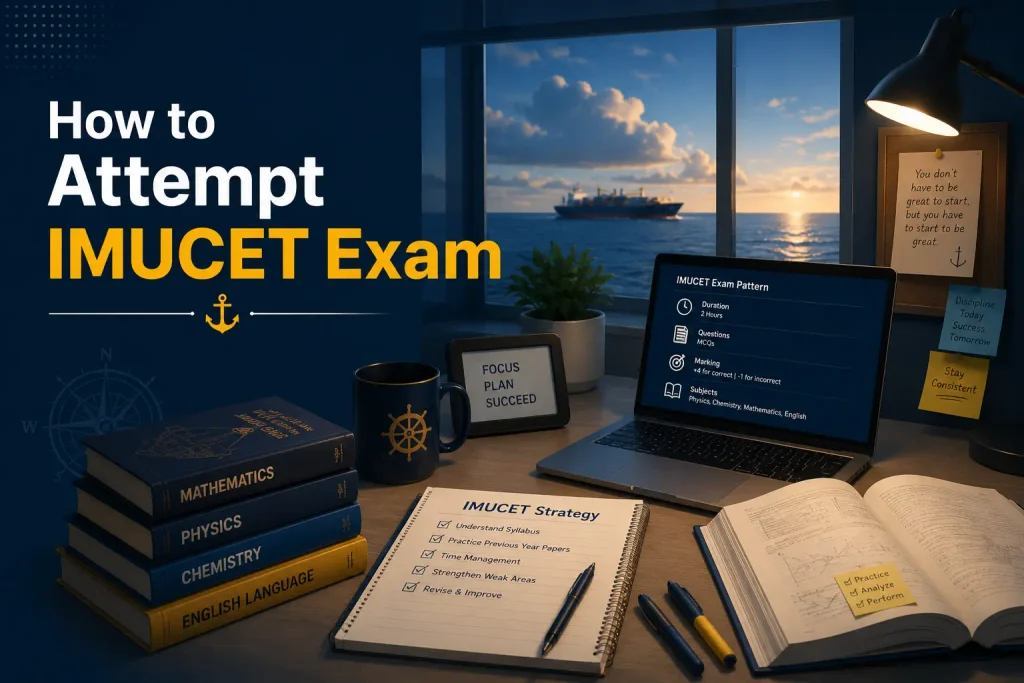
If you want to start a successful career in the Merchant Navy, qualifying for the Indian Maritime University Common Entrance Test (IMUCET) is your mandatory first step. It does not matter if you want to pursue a Diploma in Nautical Science, a Bachelor of Science in Nautical Science, or a Bachelor of Technology in Marine Engineering. You must clear this exam to secure a seat in any recognized training institute.
The main challenge is not just the difficulty of the questions, but the fast pace of the exam. You have to solve two hundred questions in just three hours. That means you get less than one minute for each question.
This comprehensive guide will show you exactly how to plan your studies, manage your time, and attempt IMUCET exam – the computer-based test efficiently.
Table of Contents
Understanding the True Structure of IMUCET
Before you start solving questions, you must know exactly what you are up against. Knowing the structure of the IMUCET exam question paper helps you divide your time properly during the test.
The exam consists of six distinct subjects. All the questions are multiple choice questions. Let us look at the detailed breakdown of the sections and marks in the table below.
Section-Wise Distribution of Questions
| Subject Name | Number of Questions | Total Marks |
| Mathematics | 50 | 50 |
| Physics | 50 | 50 |
| English | 40 | 40 |
| General Chemistry | 20 | 20 |
| General Knowledge | 20 | 20 |
| General Aptitude | 20 | 20 |
| Total | 200 | 200 |
The time allowed to complete this entire paper is exactly one hundred and eighty minutes. This means you need a great combination of speed and accuracy.
The Marking System and Negative Marking
Every correct answer gives you one mark. However, there is a catch that catches many students off guard. There is a negative marking system in place. For every incorrect answer, zero point two five marks will be subtracted from your total score. If you leave a question blank, you get zero marks for it.
Because of this rule, blind guessing can completely ruin your rank. You must only tick an answer when you are reasonably confident.
Mastering the IMUCET Syllabus Step by Step
To secure a high rank, you need to study from the correct topics. Most of the technical questions come directly from your class 11 and class 12 science textbooks.
Core Science Subjects
- Mathematics: This section carries a major portion of the weight. You must focus heavily on Calculus, Vectors, Three Dimensional Geometry, Matrices, Determinants, and Probability. Trigonometry and Coordinate Geometry are also frequently asked because they form the basis of maritime navigation calculations.
- Physics: This is another high-weightage section. You need to thoroughly prepare Electrostatics, Current Electricity, Mechanics, Optics, Magnetism, and Thermodynamics. Make sure you understand the fundamental concepts well, because the questions often test your basic understanding rather than just long calculations.
- Chemistry: This section is relatively small with only twenty questions. Focus on the Mole Concept, Atomic Structure, Chemical Equilibrium, Electrochemistry, and basic Organic Chemistry.
To make your preparation easy, you should download the official IMUCET syllabus document and print it out. Check off each topic as you finish practicing it. Utilizing structured IMUCET preparation courses can also save you time by giving you specific, exam-oriented notes for these core subjects.
English, Aptitude, and General Knowledge
Many science students spend all their time on Physics and Maths while completely ignoring the other sections. This is a huge mistake. These extra sections carry eighty marks in total, which is forty percent of the exam. They are excellent areas to boost your overall score quickly.
- English Language: You will face questions on Parts of Speech, Synonyms, Antonyms, Idioms, Phrasal Verbs, and Tenses.
- General Aptitude: This tests your logical reasoning, data interpretation, and basic math abilities. You will see questions on blood relations, number series, coding-decoding, and simple puzzles.
- General Knowledge: Keep an eye on basic static knowledge and current affairs from the past six months. Pay special attention to basic geography, oceans, major seaports, and basic inventions.
How to Plan Your Study Routine
You cannot clear a national level competitive exam by studying randomly. You need a structured routine that covers learning concepts, memorizing formulas, and practicing questions.
The Daily Study Allocation
You can divide your daily preparation hours into three main shifts:
| Shift | Focus Area | Recommended Time |
| Morning Shift | High-Weightage Concepts (Physics or Mathematics) | 3 Hours |
| Afternoon Shift | Practice Problems and Chemistry Formula Revision | 2 Hours |
| Evening Shift | English Grammar, Logical Aptitude, and Daily News | 1 Hour |
Using specific study material designed for IMUCET exams is highly beneficial during these shifts. Standard engineering entrance books are often too detailed or tough for this specific exam, so sticking to tailored resources keeps you on the right track.
The Power of Online Testing
You can read all the theory in the world, but you will not know your actual preparation level until you sit for a timed test. This is why you should regularly solve free mock tests available online.
Mock tests help you adapt to looking at a computer screen for three hours without losing focus. They show you exactly where you are making silly mistakes, allowing you to fix those errors long before the actual exam day.
Real-Time Strategy to Attempt IMUCET Exam Paper
When you enter the examination hall and sit in front of the computer screen, your strategy determines your final rank. Many intelligent students fail because they do not manage their three hours well.
The best way to attempt this paper is by using a multi-pass system. This means you do not solve the questions in a simple sequence from one to two hundred. Instead, you scan and solve the paper in rounds.
The First Pass: Securing Easy Marks
Spend the first seventy to eighty minutes looking for what teachers call low-hanging fruits. These are questions that you can read and solve in less than forty seconds.
- Start with the English, General Knowledge, and Aptitude sections. These questions do not require long calculations. You either know the answer or you do not.
- Move to Chemistry and look for direct theoretical questions or simple formula application problems.
- Scan through Physics and Mathematics to solve basic definitions, direct properties, and easy numerical questions.
By doing this, you ensure that you have seen the entire paper once and have successfully locked in all the easy marks without running out of time.
The Second Pass: Handling the Calculations
Once you have finished the first round, you will feel much more relaxed because you already have many correct answers saved. Now, dedicate the next sixty to seventy minutes to the questions that you marked as doable but time-consuming.
- Solve the multi-step numerical problems in Physics and Mathematics.
- Work through the detailed logical reasoning puzzles.
- Keep a close eye on the timer on your screen so you do not spend five minutes on a single tricky question.
The Third Pass: Review and Smart Decisions
In the final fifteen to twenty minutes of your exam, look at the remaining questions. This is where your discipline regarding negative marking is tested.
- If you can confidently eliminate two wrong choices out of the four options, it is generally worth making an educated guess.
- If you have no idea about the question or topic, leave it completely blank. Do not let negative marks destroy the score you worked so hard to build in the first two rounds.
Critical Mistakes You Must Avoid on Exam Day
Even well-prepared students can mess up their chances if they make simple errors during the examination process. Keep these pointers in mind to avoid disaster.
- Do not get stuck on a single question: If a math problem is taking more than two minutes and your calculation is not matching the options, leave it immediately and move forward. You can always come back to it later if you have time. Every question carries the exact same weight, so spending five minutes on a single hard question means you lose time to read three easy ones at the end.
- Do not guess randomly: Remember that four wrong answers will take away one full mark from your earned score. Random guessing is the primary reason why many students drop in ranks.
- Read the question completely: Sometimes, questions end with words like “which of the following is NOT true” or “find the incorrect statement.” If you rush through the sentences, you might choose the exact opposite answer by mistake. Take a deep breath and read every sentence carefully.
- Verify your roll number and details: Before starting the test, ensure that you enter your login credentials correctly on the computer screen. Listen carefully to the instructions given by the exam invigilators in the hall.
Final Checklist for the Examination Day
To avoid last-minute panic, prepare your exam kit the previous evening. Make sure you have all the required items ready to go.
- Admit Card: Take a clear printout of your official hall ticket. Check that your photograph and signature are visible on the printout.
- Identity Proof: Carry an original and valid government photo identification card, such as your Aadhaar card, passport, or school identity card.
- Photographs: Keep two recent passport-size color photographs with you, preferably matching the one uploaded in your application form.
- Stationery: Carry simple blue or black ballpoint pens for doing rough calculations on the scratch sheet provided at the test center.
Ensure that you reach the designated examination venue at least one hour before the gate closing time. Arriving early gives your mind time to settle down so you can sit for the test with a calm and focused attitude.
By understanding the test design, prioritizing high-yield chapters, and regularly assessing your skills with mock papers, you can comfortably secure a great rank. Stay disciplined with your daily routine, keep your basic concepts clear, and approach the exam paper systematically.
Enroll in IMUCET Preparation Courses
If you feel that self study is not enough to get the rank you want, you should consider enrolling in professional IMUCET preparation courses. These courses provide a structured environment that keeps you disciplined throughout your journey. When you join a course, you get a set schedule, regular assignments, and direct access to teachers who can clear your doubts immediately.
We understand that every student has different needs, which is why we offer both online and offline classes for your preparation. If you prefer the comfort of your home and want to save travel time, our online courses provide high quality video lectures and digital study material that covers the complete IMUCET syllabus.
If you learn better in a traditional classroom setting, our offline coaching center in Surat offers a focused environment where you can interact with mentors in person, solve regular free mock tests, and track your progress weekly.
Frequently Asked Questions
1. What is the minimum qualification required to sit for the IMUCET exam?
You must have completed or be appearing for your Class 12 exams with Physics, Chemistry, and Mathematics as core subjects. A minimum aggregate mark of sixty percent in these PCM subjects is mandatory to qualify for admission.
2. Is there any negative marking in the IMUCET exam paper?
Yes, the exam follows a negative marking system where zero point two five marks are deducted for every incorrect answer. No marks are deducted if you choose to leave a question unanswered.
3. Can I use a physical calculator during the computer based test?
No, you are not allowed to bring any physical calculators or electronic gadgets inside the examination hall. If a question requires calculations, you must solve it manually using the rough sheets provided by the center.
4. How many times a year is the IMUCET exam conducted?
The Indian Maritime University typically conducts this common entrance test once every year, usually around the month of June. It is important to check the official IMU website regularly during the early months of the year for registration dates.
5. Which section should I attempt first to score well in the exam?
It is best to start with English, General Knowledge, and Aptitude because they do not involve long calculations and can be solved quickly. This saves you plenty of time to tackle the tougher Physics and Mathematics questions later.