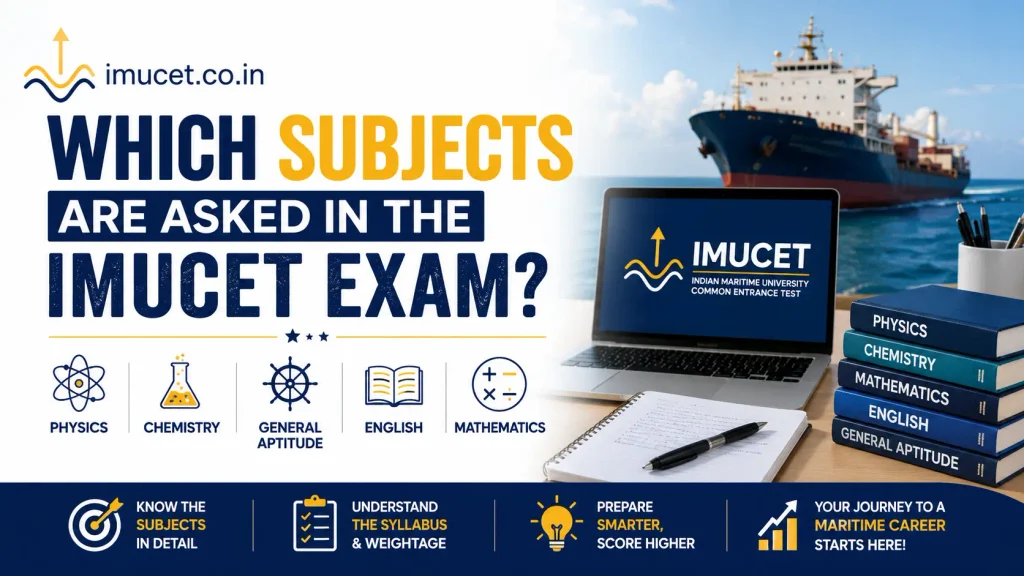
If you want to build a career in the merchant navy, you must clear the Indian Maritime University Common Entrance Test (IMUCET exam). This exam is the entry point for various maritime courses across India. Knowing what to study is the first step toward clearing this test. When you know the exact topics, you can plan your daily routine and cover everything on time. This guide will help you understand every subject and topic included in the test.
The entire paper is multiple choice questions. You will need a strong grip on your high school concepts and some additional areas specific to shipping. Let us look at how the entire exam syllabus is divided so you can start preparing systematically.
Useful Resource: You can boost your readiness by taking our comprehensive free mock tests and exploring our structured study material.
Table of Contents
Overview of the IMUCET Subjects
The IMUCET exam evaluates your knowledge across several distinct domains. While three subjects come directly from your science stream classes, the rest check your language skills, general awareness, and logic. Here is a quick look at the subjects you will see on the paper:
- Mathematics
- Physics
- Chemistry
- English
- Verbal and Non Verbal Reasoning
- Geography
- Marine Knowledge
- Psychology
The paper typically covers Physics, Chemistry, and Mathematics at Class 12 level, along with English, General Knowledge, and logical or analytical reasoning. The exact weightage can vary by year, so always cross check the official IMU information brochure for the session you are applying to.
General Exam Structure Breakdown
| Subject Category | Primary Academic Level | Core Objective of the Subject |
| Mathematics, Physics, Chemistry | Class 11 and Class 12 Level | Tests your core academic knowledge and numerical ability |
| English and Reasoning | General Aptitude Level | Evaluates your communication skills and logical analytical thinking |
| Marine Knowledge, Geography, Psychology | General Awareness Level | Assesses your awareness of the sea, earth, and basic human behavior |
Deep Dive Into Mathematics
Mathematics forms a significant part of the engineering and science streams in maritime education. You need to be fast with calculations and understand the formulas behind each concept. Regular practice is required to score well in this section.
Key Chapters in Mathematics
The math section requires you to focus on algebra, calculus, geometry, and basic trigonometry. Here is the list of chapters included in the IMUCET syllabus:
- Continuity and Differentiability
- Inverse Trigonometric Functions
- Trigonometric Functions
- Relations and Functions
- Sets
- Limits and Derivatives
- Matrices
- Determinants
- Continuity
- Application Of Derivatives
- Indefinite Integration
- Differential Equation
- Three Dimensional Geometry
- Linear Programming
- Probability
- Permutation And Combination
- Binomial Theorem
- Linear Inequalities
- Sequence and series
- Straight Lines
- Introduction to 3D
- Complex Number
Make sure you practice solving quadratic equations, finding probabilities of complex events, and solving integration problems quickly. Working out problems from past papers will give you an advantage.
Preparation Tip: Check out our specialized Mathematics IMUCET preparation course to access step by step mathematical problem solving chapters.
Deep Dive Into Physics
Physics is highly important for anyone working on a ship. Ships operate on complex mechanical, electrical, and fluid systems. This section checks if you understand the laws of nature and how machines work.
Key Chapters in Physics
You must prepare chapters from both your eleventh and twelfth grade books. The topics include:
- Electrostatic
- Current Electricity
- Magnetism And Matter
- Ray Optics and Optical Instruments
- Wave Optics
- Semiconductor Electronics, Materials, Devices and Sample Circuits
- EMI and AC
- Units and Measurements
- Motion In One Dimension
- Laws of Motion
- Work, Power and Energy
- Gravitation
- Oscillation and Waves
- Kinetic Theory
- Mechanical Properties of Solids
- Rotational Motion
- Fluid Mechanics
- Heat and Thermodynamics
- Atomic and Nuclear Physics
- Motion in a plane
- Dual nature of radiation and matter
- Moving charges and magnetism
- Electromagnetic Waves
You should focus on core formulas like the laws of motion, fluid pressure formulas, and current electricity laws. Simple numerical questions are common in this section.
Preparation Tip: Check out our comprehensive study material to simplify your physics preparation.
Deep Dive Into Chemistry
Chemistry helps you understand the properties of fuels, cargo safety, and prevention of metal rust on ships. The syllabus covers physical, organic, and inorganic chemistry concepts from your high school classes.
Key Chapters in Chemistry
The questions come from basic principles as well as complex organic chains. The topics are:
- Solutions
- Electro chemistry
- Chemical Kinetics
- D and F Block Elements
- Coordination Compounds
- Haloalkanes and Haloarenes
- Alcohols, phenols and Ethers
- Aldehyde, Ketone and Carboxylic acid
- Amines
- Biomolecules
- Some Basic Concepts of Chemistry
- Atomic Structure
- Classification of Elements and Periodicity in Properties
- Chemical Bonding and Molecular Structure
- Chemical Thermodynamics
- Equilibrium
- Redox reactions
- Organic Chemistry
- Hydrocarbons
- Organic Chemistry Principles and Techniques
Core Focus Areas in Chemistry
| Chemistry Branch | Important Focus Areas |
| Physical Chemistry | Solutions, Chemical Kinetics, Electrochemistry, Thermodynamics |
| Inorganic Chemistry | Periodic Table trends, D and F Block, Coordination Compounds |
| Organic Chemistry | Hydrocarbons, Functional groups like Alcohols, Aldehydes, Amines |
Preparation Tip: Boost your chemistry score by reviewing our structured chemistry study material and practice guides.
Deep Dive Into English
English is the global language of the shipping industry. Clear communication is a safety requirement on international waters. This section tests your basic grammar, sentence structure, and vocabulary skills.
Key Chapters in English
You can prepare for this section by revising standard grammar rules. The specific topics are:
- Noun
- Finding Error in Nouns
- Pronoun
- Verb
- Adverb
- Modals
- Determiners
- Gender
- Preposition
- Predicate
- Numbers
- Direct Indirect Speech
- Phase and Clause
- Sentences
- Active and Passive Voice
- Tenses
- Adjectives
- Synonym and Antonym
- General English Questions
Reading simple newspapers daily and practicing sentence conversion will help you score maximum marks in this section. Pay special attention to prepositions and spotting hidden errors in sentences.
Recommended Guide: To understand the language patterns tested in the exam, check out our latest English for IMUCET study material.
Deep Dive Into Verbal and Non Verbal Reasoning
Reasoning tests your mental alertness, logical thinking, and problem solving speed. It shows how well you can perform under pressure. This section contains both numerical puzzles and shape based pattern questions.
Key Chapters in Reasoning
The analytical portion contains a wide variety of logic problems. The chapters are:
- Time, speed and distance
- Time and work
- Percentage
- Simple and Compound Interest
- Profit and loss
- Ratio and proportion
- Pipes and cisterns
- Average
- Calendar
- Clock
- Chain rule
- Direction
- Blood relation
- Series
- Analogy
- Classification
- Mirror Image
- Patten Classification
- Figure Matrix
- Paper Folding And Paper Cutting
- Rule Deduction
- Dot Situation
- Shape Construction
- Image Analysis
- Cubes And Dices
- General Sample Questions
You should solve puzzle types daily. Non verbal questions that involve tracking moving dots or unfolding papers require visual practice. The more puzzles you solve, the faster your mind works during the actual exam.
Recommended Guide: Pair your readings with our complete Reasoning study material for the best results.
Deep Dive Into Geography
Geography is closely linked to navigation. A mariner needs to understand world layouts, time zones, ocean behavior, and global atmospheric patterns. This section tests your general awareness of our planet.
Key Chapters in Geography
The syllabus includes basic physical geography and global facts:
- The Universe
- Earth’s Movement
- Geological History Of Earth
- Earth’s Atmosphere
- Clouds
- Layers Of The Earth
- Lithosphere and Types Of Mountains
- Latitude And Longitude
- Ocean Currents
- 7 Continents Of The World
- Country and Capitals
- International Boundaries
- Oceans And Seas
- Major Strait and Rivers
- India Physical Division
Understanding latitude and longitude is helpful because modern navigation relies entirely on coordinates. You should also remember major water bodies and global shipping pathways.
Your Next Step: To feel completely confident before the exam day, make sure to review our specialized geography study material.
Deep Dive Into Marine Knowledge
This subject introduces you to the actual business of the merchant navy. It tests whether you have a genuine interest in the field. You do not need deep technical engineering knowledge, but you must know the fundamentals of the shipping world.
Key Chapters in Marine Knowledge
The chapters designed to check your shipping interest include:
- Introduction to Merchant Navy
- International Maritime Organization and D.G. Shipping
- Career Graph In Merchant Navy
- Types Of Ship
- Types Of Cargoes
- Ports Of India And World
- International Sea Routes
- Famous Shipping Canals
- National and International Maritime Day
- Advantages And Disadvantages Of Merchant Navy
You should learn about basic ship types like oil tankers, container ships, and bulk carriers. Knowing major canals like the Suez Canal and Panama Canal is also important for this section.
Boost Your Score: Take advantage of our marine knowledge study material to see how much marine knowledge you already possess.
Deep Dive Into Psychology
Working on a ship means living away from home with a small crew for months. This requires mental strength, situational awareness, and teamwork. The psychology section evaluates your natural responses to different situations.
Key Chapters in Psychology
This section is less about memorizing textbook chapters and more about understanding personality assessment tools. The topics are:
- Introduction to Psychology
- Non verbal Communication
- Self Descriptive Test
- Situation Reaction Test
- Thematic Apperception Test or Picture Perception Test
- Word Association Test
When answering these questions, honesty and positive thinking are key. The questions are looking for stability, a cooperative nature, and leadership qualities under unexpected situations.
Pro Tip: Access our curated psychology study material today to master every concept in the syllabus.
Effective Preparation Tips for the Exam
Now that you know the detailed syllabus, you need a smart plan to cover everything. Since the exam has multiple sections, balancing your time is critical. Here are practical steps to structure your studies:
- Create a balanced timetable that allocates time to both tough science subjects and general aptitude topics.
- Practice simple mental math tricks to speed up your reasoning and mathematics section.
- Keep a small notebook for physics formulas, chemistry reactions, and geographical facts for quick weekly revision.
- Read basic English articles to naturally improve your grammar and vocabulary without stress.
- Solve regular sample papers to check how well you manage your time when dealing with multiple subjects at once.
Suggested Study Timeline Plan
| Preparation Stage | Recommended Action Plan |
| Initial Phase | Understand the full syllabus framework and collect high quality study material |
| Core Phase | Dive deep into Class 11 and 12 science topics while keeping logical skills sharp with daily puzzles |
| Final Phase | Enroll in IMUCET preparation courses and solve multiple free mock tests to master your time management |
By preparing systematically across all these subjects, you can attempt your exam with confidence. Focus on building strong basics, practice regularly, and keep track of your progress as you cover each chapter. Good luck with your preparation!
Frequently Asked Questions
1. What is the academic level of the science subjects asked in the IMUCET exam?
The Physics, Chemistry, and Mathematics questions are based on the standard Class 11 and Class 12 high school curriculum.
2. Do I need advanced engineering knowledge to clear the Marine Knowledge section?
No, advanced technical knowledge is not required. This section only tests your fundamental awareness of the shipping industry, such as basic ship types, major global canals, and famous international sea routes.
3. How is the Psychology section evaluated in the IMUCET exam?
Instead of textbook memorization, this section uses situational and behavioral tests like the Situation Reaction Test to evaluate your mental strength, teamwork, and natural responses under pressure.
4. Why is English considered an important subject for the IMUCET exam?
English is the global language of the international shipping industry and a critical safety requirement for communication at sea, which is why the exam rigorously tests your basic grammar, vocabulary, and sentence structure.
5. What is the best strategy to manage time across so many different subjects?
The best approach is to create a balanced timetable that pairs tough science topics with daily logic puzzles, while regularly solving full-length mock tests to practice switching between different subject sections.