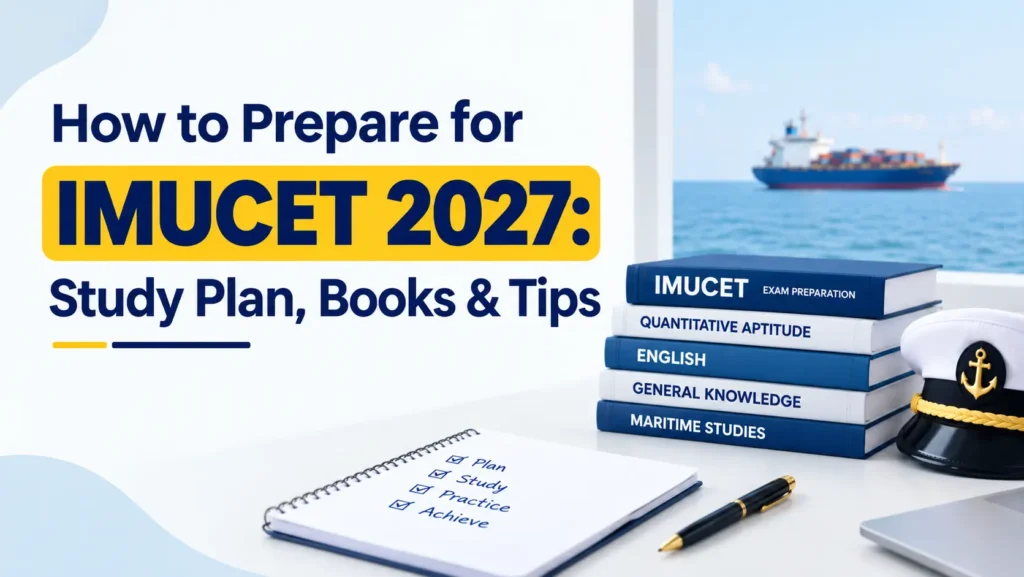
Preparing for IMUCET 2027 can feel like a massive task when you are standing at the starting line without a clear roadmap. You have multiple subjects to balance, hundreds of complex concepts to revise, endless practice problems to solve, and time-bound tests to master. On top of all this, if you are aspiring to build a successful career in the Merchant Navy, you also have to keep an eye on company sponsorship selections that often happen alongside or right after the entrance exam.
The good news is that you do not have to tackle everything all at once. When you break down the entire journey into manageable daily and weekly goals, the preparation becomes surprisingly structured and achievable. With a firm grip on the official IMUCET syllabus, a well-planned schedule, and reliable study material, you can steadily build the conceptual clarity and speed needed to secure a top rank.
Whether you choose to study independently or enroll in structured IMUCET preparation courses, having a well-defined strategy is what separates successful candidates from the rest. This comprehensive guide will walk you through everything you need to know to prepare for IMUCET 2027 from absolute ground zero.
What is IMUCET 2027?
IMUCET stands for the Indian Maritime University Common Entrance Test. It is a single, national-level Computer-Based Test conducted by the Indian Maritime University. Clearing this examination opens the doors to undergraduate maritime programs across various IMU campuses and affiliated training institutes throughout India.
If you are serious about joining the Merchant Navy, this is the primary entrance exam you must focus on. The entrance exam serves as the Gateway for popular courses such as:
- B.Tech in Marine Engineering
- B.Sc. in Nautical Science
- Diploma in Nautical Science (DNS)
- B.S. Naval Architecture and Ocean Engineering
The exam consists entirely of multiple-choice questions designed to test your core academic foundation, logical reasoning skills, and general awareness. Because you have to answer a high volume of questions in a limited timeframe, accuracy alone will not cut it. You need speed, strategy, and thorough subject knowledge.
Understanding the Exam Pattern and Marking Structure
Before you start picking up your textbooks, you need to know the structure of the paper you are up against. Understanding the distribution of marks allows you to divide your daily study time efficiently across all subjects.
The general structure of the IMUCET examination is summarized below:
| Particulars | Details |
| Exam Mode | Computer-Based Test (CBT) |
| Question Type | Multiple Choice Questions (MCQs) |
| Duration | 3 Hours (180 Minutes) |
| Total Questions | 200 Questions |
| Total Marks | 200 Marks |
| Language Medium | English |
Subject-Wise Breakdown
To create a balanced study routine, you must look at how the 200 questions are distributed across individual subjects:
| Subject | Number of Questions | Weightage Percentage |
| Mathematics | 50 Questions | 25% |
| Physics | 50 Questions | 25% |
| English | 40 Questions | 20% |
| Chemistry | 20 Questions | 10% |
| Aptitude | 20 Questions | 10% |
| General Science | 20 Questions | 10% |
Looking at this breakdown, you can see that Mathematics and Physics together make up half of the entire exam. While these two subjects require a major portion of your preparation time, you must not ignore English, Chemistry, Aptitude, or General Science. Every single mark matters when merit lists are drawn, and scoring well in the non-core sections can easily boost your overall rank.
Eligibility Criteria to Keep in Mind
You must ensure you meet the basic academic eligibility criteria before diving deep into your preparation:
- You must have completed or be appearing for your Class 12 (or equivalent) board examinations.
- Physics, Chemistry, and Mathematics (PCM) must be your compulsory subjects.
- You generally need a minimum aggregate of 60% in PCM in Class 12.
- You must have secured at least 50% marks in English in either Class 10 or Class 12.
Comprehensive Breakdown of the IMUCET Syllabus
The IMUCET syllabus is primarily aligned with the Class 11 and Class 12 NCERT curriculum. Having a strong grip on your school textbooks is the absolute foundation of your preparation.
1. Mathematics
Mathematics demands logical thinking and active problem-solving skills. Simply reading through solved examples will give you a false sense of confidence. You must pick up a pen and solve problems yourself.
Key topics to cover include:
- Matrices and Determinants
- Probability and Statistics
- Differential and Integral Calculus
- Vectors and Three-Dimensional Geometry
- Complex Numbers and Quadratic Equations
- Trigonometry and Permutations & Combinations
2. Physics
Physics is a blend of conceptual understanding and mathematical application. You must focus on understanding the physical principles behind every phenomenon rather than just memorizing formulas blindly.
Key topics to cover include:
- Kinematics and Laws of Motion
- Work, Energy, and Power
- Electrostatics and Current Electricity
- Magnetic Effects of Current and Magnetism
- Optics (Ray and Wave)
- Thermodynamics and Oscillations
3. Chemistry
Chemistry is often considered a high-scoring section if you prepare it systematically. Since it carries 20 questions, covering fundamental formulas and reactions can yield quick marks without consuming too much time during the exam.
Key topics to cover include:
- Atomic Structure and Chemical Bonding
- Solutions and Electrochemistry
- Periodic Table and Periodicity
- Basic Principles of Organic Chemistry
- Hydrocarbons and Surface Chemistry
4. English
The English section tests your grasp of basic grammar, vocabulary, and reading comprehension. Regular reading habits will make this section much easier to handle.
Key topics to cover include:
- Reading Comprehension Passages
- Synonyms and Antonyms
- Error Spotting and Sentence Correction
- Idioms and Phrases
- Fill in the Blanks and Prepositions
5. Aptitude and General Science
Aptitude questions evaluate your logical reasoning, visual spatial skills, and problem-solving speed. General Science covers basic everyday scientific facts that you studied up to Class 10.
Key topics to cover include:
- Coding-Decoding and Series Completion
- Blood Relations and Direction Sense Tests
- Syllogisms and Data Interpretation
- Basic Everyday Physics, Chemistry, and Biology Concepts
Step-by-Step Guide: How to Start Preparing from Zero
If you are beginning your preparation from absolute scratch, the sheer volume of topics can seem overwhelming. You do not need to master the entire syllabus in a week. Follow this step-by-step framework to build your knowledge systematically.
Phase 1: Understand the Exam Landscape
Spend your first couple of days getting familiar with the question styles, exam timing, and pattern. Look at previous years’ papers to understand the difficulty level. This step prevents you from wasting energy on topics that fall outside the exam domain.
Phase 2: Divide the Syllabus into Micro-Goals
Break down the vast IMUCET syllabus into smaller, manageable weekly targets. Instead of setting a vague goal like “I will complete Physics this month,” set specific targets such as “I will complete Kinematics theory and solve 100 practice questions by Sunday.” Small wins build massive momentum over time.
Phase 3: Master the Fundamentals Using Basic Study Material
Before attempting advanced level problems, clear your basic concepts using standard NCERT textbooks. Focus on understanding core definitions, derivations, and basic numerical applications. Strong fundamentals will allow you to solve even complex, modified questions during the actual test.
Phase 4: Begin Daily Topic-Wise Practice
After learning any concept, solve topic-wise practice questions immediately. Do not defer practice to the end of the month. Working through practice problems fixes the concepts in your long-term memory and highlights your operational weak spots right away.
How to Draft a Realistic IMUCET Study Schedule
A good study schedule is not one that forces you to sit at your desk for fourteen hours a day until you burn out. What you need is a sustainable, realistic schedule that you can comfortably follow for months without losing focus.
A dedicated 3 to 4 hours of focused, distraction-free study every single day is far more effective than an unpredictable 10-hour cramming session once a week.
Daily Time-Allocation Model
Here is a balanced daily study structure you can adopt:
| Time Allocation | Focused Activity | Objective |
| 60 Minutes | Core Subject Theory (Physics/Maths) | Learn new concepts or revise detailed notes. |
| 60 Minutes | Question Practice | Solve 30 to 40 numericals or MCQs on the learned topic. |
| 40 Minutes | Secondary Subject (Chemistry/English/Aptitude) | Rotate daily between Chemistry, English, and Aptitude. |
| 30 Minutes | Revision and Error Logging | Revisit past notes and update your mistake notebook. |
Subject-Wise Strategy for Top Performance
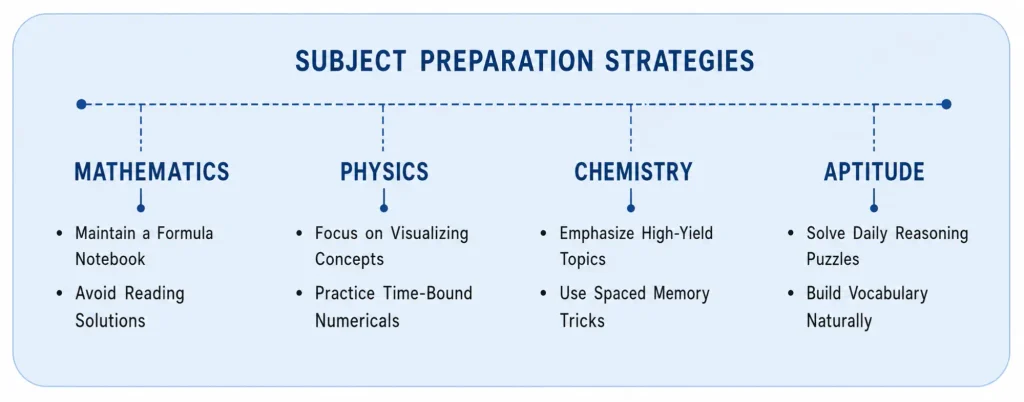
Every subject in the IMUCET paper requires a slightly tailored tactical approach.
Practical Math Strategy
- Maintain a Formula Notebook: Write down all essential formulas, identities, and shortcut tricks in a separate notebook. Review this notebook every morning.
- Avoid Reading Solutions: When practicing, try to solve the problem completely on your own. Do not look at the answer key after reading the first line of the question.
Conceptual Physics Strategy
- Focus on Visualizing Concepts: Physics is about how the real world operates. Draw simple diagrams for mechanics, ray diagrams for optics, and circuit diagrams for electricity to visualize the problem clearly.
- Practice Time-Bound Numericals: Set a timer for 20 minutes and try to solve 15 physics numericals to build both speed and accuracy under pressure.
Smart Chemistry Strategy
- Emphasize High-Yield Topics: Focus heavily on Physical Chemistry formulas and basic Organic reactions.
- Use Spaced Memory Tricks: Since Chemistry contains factual data, revise your notes at regular intervals (1 day, 7 days, 30 days) to retain definitions and trends long-term.
Quick-Scoring English & Aptitude Strategy
- Solve Daily Reasoning Puzzles: Dedicate 15 to 20 minutes daily to logical reasoning puzzles. Aptitude speed improves exponentially with continuous exposure.
- Build Vocabulary Naturally: Read quality news articles or books daily. Note down new words along with their meanings, synonyms, and antonyms.
The Role of Mock Tests and Performance Analysis
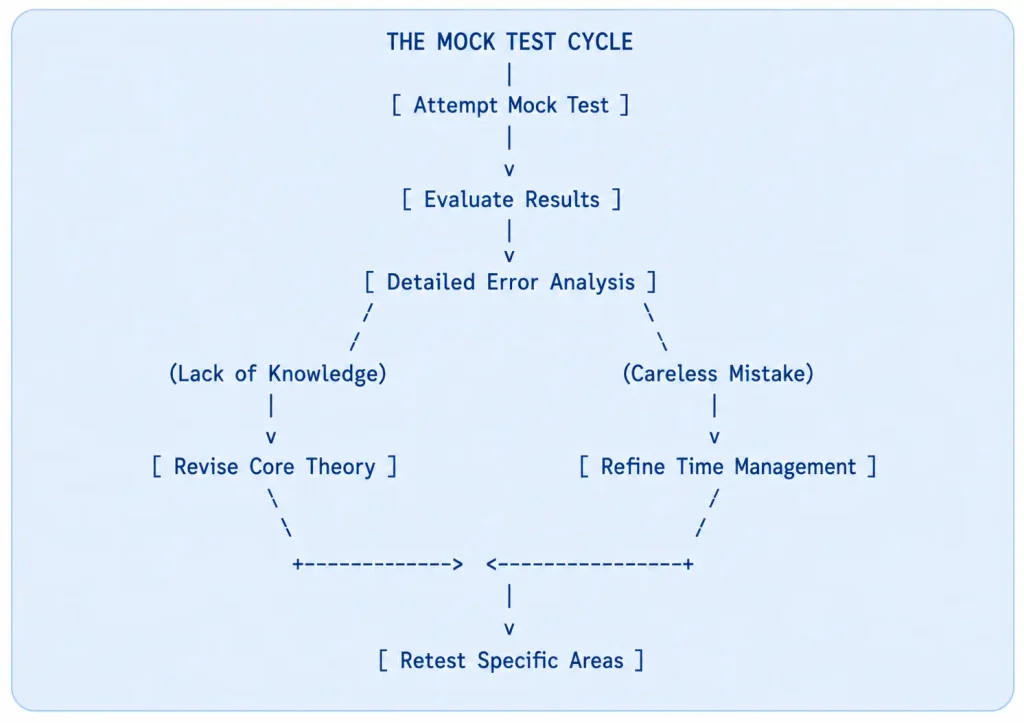
Practicing isolated questions is useful, but attempting full-length mock tests under real exam conditions is what actually builds exam temperament. You cannot expect to perform smoothly in a 3-hour computer-based exam if you have never sat through one during your preparation phase.
Why You Must Take Regular Mock Tests
- Simulates Real Exam Stress: Taking a time-bound test conditions your mind to make calm decisions under severe time pressure.
- Improves Time Management: You quickly learn how much time to allocate per question and when to skip a lengthy problem.
- Highlights Hidden Weaknesses: Mock test results show you exactly which topics need further revision before the main exam.
How to Properly Analyze a Mock Test
Taking a test is only half the work; analyzing it is where the real growth happens. After every test, spend at least one hour reviewing your performance and categorizing your wrong answers:
- Knowledge Gaps: Questions you couldn’t attempt because you didn’t know the concept. Action: Re-read the theory for that topic.
- Calculation Errors: Questions where your approach was right, but you made a basic calculation mistake. Action: Slow down slightly during calculations.
- Conceptual Errors: Questions where you applied the wrong formula or misunderstood the concept. Action: Re-learn the core theory and re-solve basic examples.
- Time Traps: Questions that took you more than 3 minutes to answer. Action: Practice shortcut techniques or learn to skip such questions early.
To track your readiness against candidates nationwide, you can take a free mock test today to evaluate your current standing and identify key areas for improvement.
Essential Study Material for IMUCET Preparation
Collecting dozens of books from various sources will only clutter your desk and create unnecessary panic. The key to cracking competitive entrance exams is using a concise set of high-quality resources and revising them multiple times.
Here is a recommended list of study material you should rely on:
- NCERT Physics (Class 11 & 12): Fundamental conceptual clarity and theoretical questions.
- NCERT Chemistry (Class 11 & 12): Invaluable for basic inorganic, organic, and physical chemistry concepts.
- NCERT Mathematics (Class 11 & 12): Essential base for understanding formulas and standard problem patterns.
- Specialized IMUCET Question Banks: Topic-wise multiple-choice practice sets explicitly designed for maritime entrance exams.
- Previous Year Question Papers: Excellent for understanding the evolving difficulty level and question style over time.
- Formula Sheets and Error Notebooks: Personalized short notes created by you during your preparation journey.
If you are looking for structured learning, we provide specialized IMUCET preparation courses equipped with complete, updated physical and digital study material sets, topic-wise practice modules, and formula sheets tailored to the latest syllabus.
IMUCET Preparation vs. Merchant Navy Sponsorship
One of the biggest misconceptions among maritime aspirants is that clearing IMUCET is the only thing they need to worry about. In reality, if you are planning to pursue courses like Diploma in Nautical Science (DNS), getting a sponsorship from an approved shipping company before or alongside your exam is crucial.
Sponsorship means a reputed shipping company evaluates you through written tests and interviews, promising you a berth for your onboard cadetship training after you clear your academic course.
Comparing Entrance Preparation and Sponsorship Preparation
| Parameter | IMUCET Preparation | Company Sponsorship Preparation |
| Primary Focus | Academic syllabus (Physics, Math, Chemistry, English, Aptitude). | Personality, communication skills, technical basics, and aptitude. |
| Testing Mode | Computer-based multiple-choice exam. | Online written test followed by panel interviews and medicals. |
| Key Requirement | High numerical solving speed and conceptual accuracy. | Strong spoken English, confidence, leadership qualities, and clear maritime awareness. |
| Final Outcome | Secures admission rank in university campuses and institutes. | Secures guaranteed onboard cadetship training with a shipping line. |
To save time and avoid double preparation effort, candidates often choose integrated coaching models. We offer comprehensive programs that cover both written entrance syllabus prep and 1-on-1 interview training, communication workshops, and sponsorship guidance under one structured guidance plan.
Self-Study vs. Structured Preparation Courses
Can you crack IMUCET through self-study alone? Yes, absolutely. If you are highly self-disciplined, have crystal-clear concepts in Class 11 and Class 12 PCM, and can consistently track your own performance, self-study can definitely yield excellent results.
However, many students find it challenging to maintain uniform momentum across several months. They often run into obstacles such as:
- Difficulty in staying consistent without a fixed routine.
- Inability to locate exam-accurate practice questions and authentic past papers.
- Lack of guidance to clear tricky doubts quickly.
- Ineffective performance analysis after taking practice tests.
- Confusion regarding shipping company sponsorship application deadlines and interview prep.
This is where enrolling in dedicated IMUCET preparation courses can give you a clear structural advantage. A well-organized program keeps you accountable, offers daily targeted assignments, provides high-quality mock tests with All-India ranking, and ensures your preparation stays aligned with the latest exam trends.
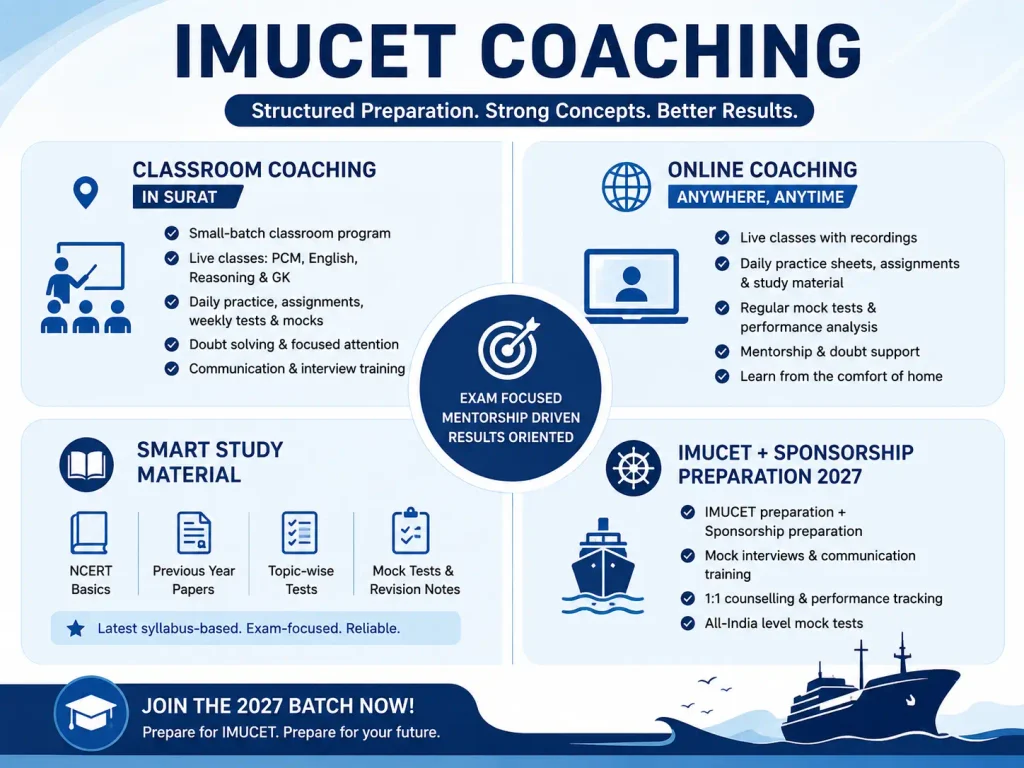
Whether you prefer sitting in a physical classroom or require the flexibility of learning from home, we provide classroom preparation programs as well as live IMUCET online coaching batches equipped with recorded sessions, live doubt resolution, and personalized mentorship.
Common Mistakes to Avoid During Your Preparation
Steering clear of common preparation mistakes will save you dozens of wasted hours and keep your performance trajectory moving upward smoothly.
- Ignoring Non-PCM Sections: Many candidates spend 100% of their time on Physics and Mathematics while ignoring English, General Science, and Aptitude. Remember, these non-PCM sections carry 80 marks out of 200 and are often much easier to score in.
- Collecting Too Many Books: Buying ten different reference books for the same subject leads to confusion. Stick to core textbooks, curated study material, and targeted question banks.
- Delaying Revision to the Last Month: If you do not revise completed chapters weekly, you will forget major concepts by the time you reach the final month. Implement spaced repetition right from week one.
- Focusing Only on Theory Without Solving Questions: Reading theory gives you the illusion of learning. True learning in competitive exams only happens when you apply that theory to solve unknown problems.
- Not Maintaining an Error Log: Repeating the same mistake across multiple mock tests is a waste of effort. Maintain a notebook dedicated solely to recording and reviewing your errors.
- Overlooking Sponsorship Deadlines: Waiting until after your IMUCET results are declared to apply for shipping company sponsorships can cause you to miss major application windows. Prepare for both simultaneously.
Final Checklist for IMUCET 2027 Success
As you build your study routine, keep this quick operational checklist handy to ensure your preparation stays on track:
[ ] Download and review the latest official IMUCET syllabus completely.
[ ] Collect authentic, high-quality study material and past practice papers.
[ ] Draft a realistic daily schedule allocating time for theory, practice, and revision.
[ ] Create dedicated formula books for Physics and Mathematics.
[ ] Attempt short, topic-wise quizzes after completing every chapter.
[ ] Take regular full-length mock tests to monitor your speed and accuracy.
[ ] Analyze every mock test thoroughly to fix calculation and conceptual errors.
[ ] Begin practicing spoken English and interview basics for sponsorship rounds.
By approaching your preparation with clarity, consistency, and a well-structured study plan, you can tackle the IMUCET 2027 examination with complete confidence and lay a strong foundation for your future career in the Merchant Navy.
1. Is IMUCET 2027 difficult to crack for average students?
IMUCET is moderately challenging, but any average student with consistent daily practice, clear Class 11 and Class 12 basic concepts, and regular mock test preparation can easily secure a high rank.
2. How many months of preparation are needed for IMUCET 2027?
A dedicated preparation timeframe of 4 to 6 months is generally sufficient to cover the entire syllabus, complete multiple rounds of revision, and attempt full-length practice tests comfortably.
3. Are NCERT textbooks sufficient to prepare for the IMUCET exam?
NCERT textbooks are excellent for establishing your basic conceptual foundation in Physics, Chemistry, and Mathematics, but you must supplement them with competitive MCQ question banks and mock tests to build solving speed.
4. Is coaching necessary to clear the IMUCET exam with a top rank?
Coaching is not mandatory, but enrolling in structured preparation programs provides tailored study material, regular testing, doubt-solving support, and sponsorship interview guidance that keeps your preparation disciplined.
5. What subjects carry the highest weightage in the IMUCET paper?
Mathematics and Physics carry the highest individual weightage with 50 questions each, together accounting for 50% of the overall examination paper.
6. When should I start attempting full-length IMUCET mock tests?
You should begin taking full-length mock tests once you have completed around 60% to 70% of your syllabus, leaving the last month dedicated almost entirely to mock tests and performance analysis.